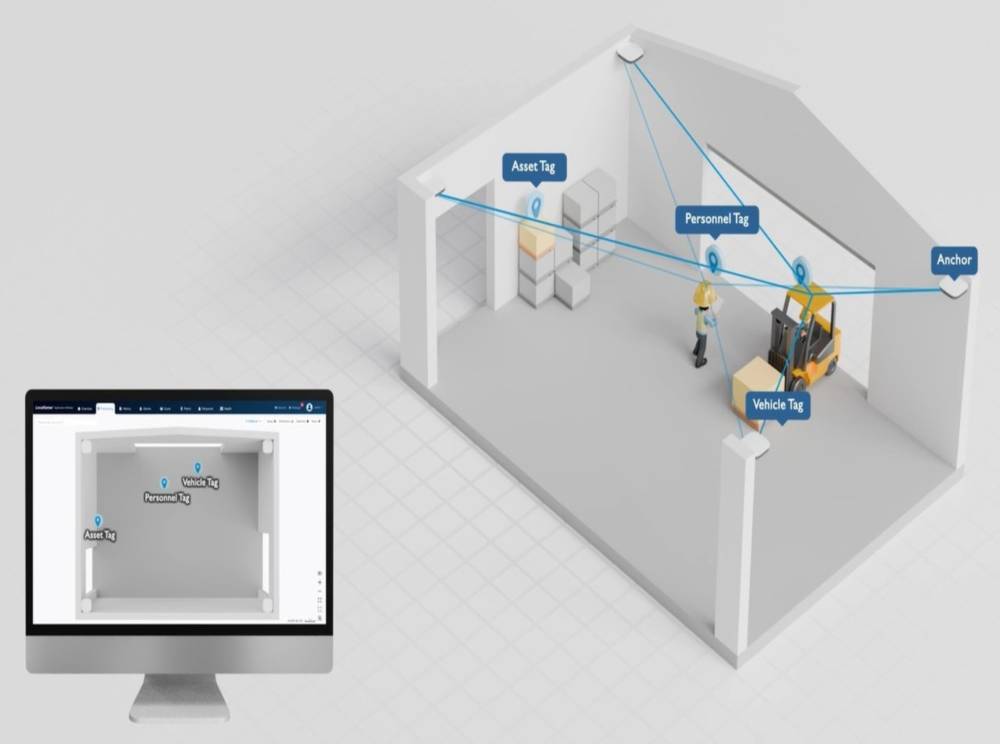
Ultra-wideband also known as UWB is a wireless communication that enables devices to calculate exact distance and direction between each other with centimetre-level accuracy.
What is UWB?
UWB (Ultra-wideband) technology enables communication and positioning by using ultra-short pulse signals with a broad frequency range, typically spanning several GHz.
Unlike Wi-Fi or Bluetooth, which operate within specific frequency bands, UWB achieves ultra-high time resolution in complex environments. It calculates distance by measuring the Time of Flight (ToF) of signals, distinguishing arrival time differences of multipath signals.
By using multiple anchors and triangulation algorithms, UWB provides accurate positioning with centimetre or even millimetre accuracy, making it ideal for high-accuracy applications.
UWB vs Traditional Technologies
In the realm of wireless technologies, UWB has emerged as a significant contender, and it exhibits notable differences when compared to traditional technologies. Traditional technologies such as RFID, WiFi, BLE Beacon, and Zigbee have their own sets of capabilities and limitations.
Summary
From indoor to outdoor positioning and automotive advancements to asset tracking, healthcare, robotics, and AR/VR applications, UWB is revolutionizing the way we live, work, and interact with technology. With its unmatched precision, range, and data transfer capabilities, UWB is taking over the world, unlocking a future where connectivity, efficiency, and innovation thrive.
Call us now as our UWB are certified by Singapore IMDA.
